Development
Koudelka had quite an interesting development process, and much of the game's design was innovative for its time. It was created by Kikuta Hiroki, who was mainly known as a composer, having done the scores for Squaresoft games like Romancing SaGa and the Mana series. Kikuta opened his own studio called Sacnoth with other former Square employees in 1997 and began development on Koudelka. The entire team consisted of around 30 people.
Kikuta said he wanted to create a game because he had original ideas about how to improve upon RPGs, and he felt that he would have comprehensive insight into each part of a game's development. Unfortunately, he discovered that his staff were not ready to take on innovative challenges and create something outside of the norm, and he retired as CEO after releasing Koudelka.
Turn-Based Combat
Kikuta wanted to do something different from the typical turn-based RPG combat that was popular at the time. His initial plan was a real-time battle system with free movement and an interactive environment. His employees from Square were reluctant to try this, however, and convinced him to fall back on traditional RPG elements. Kikuta later regretted giving in, but the game was ultimately shipped with a turn-based combat system on a grid and random encounters.
Personally, I wish Kikuta had been able to stick with his original plan. While Koudelka is my favorite game of all time, its combat is admittedly its weakest point. There are aspects of it that I like, such as the ability to customize each character's stats, but I would have preferred a more active combat scenario, and I think it would've added some much-needed challenge to the game. Art director Itakura Matsuzo even admitted the game was too easy in an interview with GameSpot, stating, "It was our intention that even adults, who don't usually play video games, could see the ending of the game. For that reason, we've made the battle system a little easier, but it could have been a bit more complicated."
Motion Capture and Voice Acting
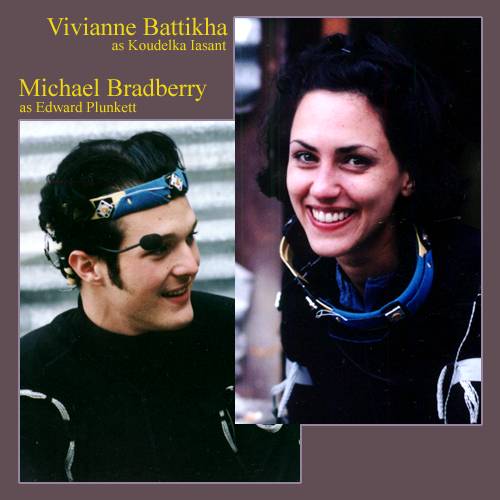
One aspect of development in which Koudelka was highly innovative was its character models and their animations. Sacnoth used motion capture, which was a fledgling technology at the time, to add drama to each scene and make the characters' physical movements more realistic. To accomplish this, they collaborated with Futurelight, a technical studio out of Los Angeles.
The sound was recorded at the same time as the motion capture, with sound engineer Keith Garcia at the helm. Sacnoth hired theatre actors to perform the script, and the end result is that watching Koudelka's scenes often feels like viewing a stage play. The animations are dynamic and engaging, and the voice acting is dramatic in the best way. It really suits the Gothic setting and the intensity of the narrative.
My only complaint with the voice acting is that I wish the characters had Welsh and Irish accents. The game takes place in Wales, with James being Irish, and it would add a lot to the realism if the characters had accents that matched the location. Instead, the American actors kept their own accents while performing. They did a fantastic job acting and injecting emotion into every scene, but I wish realistic accents had been more of a priority.
Location Scouting and Art Design

Sacnoth did something that was rare for video games at the time: location scouting. The team visited Pembrokeshire, Wales, to get an idea of what Koudelka's setting should look like. Of Pembrokeshire, Kikuta said the following:
The area is a land with a mysterious landscape that suddenly appears from the meadow and extends to the horizon. There are a large number of monasteries and castle ruins around it. Some of them are alive and well in memory of the past, but there are many remains that have been almost ruined. St. David's Church was able to delight our eyes in the Middle Ages, as well as help to understand the unique atmosphere of the stone church. In addition, the dark, dark air created by the drooping clouds and rain is something that can not be imagined unless you actually stand there. It was also a great and meaningful attempt to photograph the walls and stonework of the nearby monastery and use them as textures for 3D models.
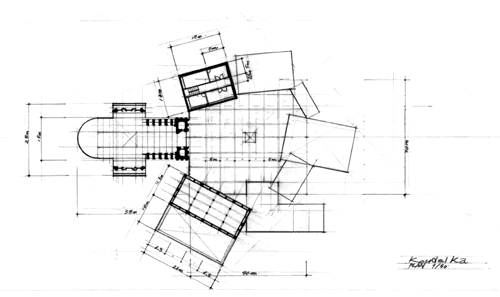
The game was ultimately set in Aberystwyth because Kikuta wanted a location that was easy to get to from Ireland, on the coastal side next to it, but his description of Pembrokeshire fits the game perfectly. The dark air, drooping clouds, and rain are evident in the opening scenes. And it's easy to tell that Nemeton Abbey was heavily inspired by St Davids Cathedral. Sacnoth had limitations when developing the 3D models that prevented them from creating a structure exactly like the real cathedral, but they sketched designs and were able to come up with a similar Gothic monastery that became Koudelka's main location. Below are some early designs of Nemeton by Yasuzo Matsuno.


When designing Koudelka herself, Yuji Iwahara drew over 100 sketches that Kikuta described as "trial and error" in trying to design a costume that would fit the restraints of polygon modeling. He said the essence of the character was grasped from the beginning, however, with the final result being similar to Iwahara's first drawings.
The polygon model was done by Shinji Watanabe, who had no previous experience but captured Kikuta's eye with the passionate movement of the characters in the promotional movie he put together. In the end, the character modeling proved to be one of the most difficult aspects of Koudelka's development because of the staff's inexperience, taking over six months to complete. Kikuta mentioned that he had to speak to Watanabe and his staff more often, giving detailed instructions to get them to complete the project up to the standards he was looking for.

Audio Design
Kikuta composed the soundtrack for Koudelka, and he said it was the easiest part of the process because music is a natural behavior for him, like breathing. The score was arranged by Kikuta and Nick Ingman, an English composer who primarily worked on the strings and choral arrangements. Kikuta used Atari Notator, now known as Logic Pro, to create most of the game's songs (including that iconic battle music). Koudelka's music was largely influenced by church music and hymns, using ambient sounds and short tracks rather than looping songs. It had less music than the average RPG, so the soundtrack was finished rather quickly, within six months.
While Koudelka's music can be quite repetitive, especially the previously linked battle theme, I think it's a good example of quality over quantity. I never get tired of hearing the three battle songs -- "Waterfall" for regular battles, "Incantation" for boss battles, and "Patience" for the final boss -- because they're just that good. I think Kikuta really outdid himself with those tracks. I also think the opening song, "Requiem," does a great job of pulling you into the game's moody setting and mysterious plot. It's a sparse but lovely vocal track that was performed by British singer Catherine Bott. The music is quite minimal and ambient overall, which works for Koudelka's dark and misty world.
Credits:
- RocketBaby's interview with Kikuta
- Koudelka Director's Cut by Kikuta Hiroki